
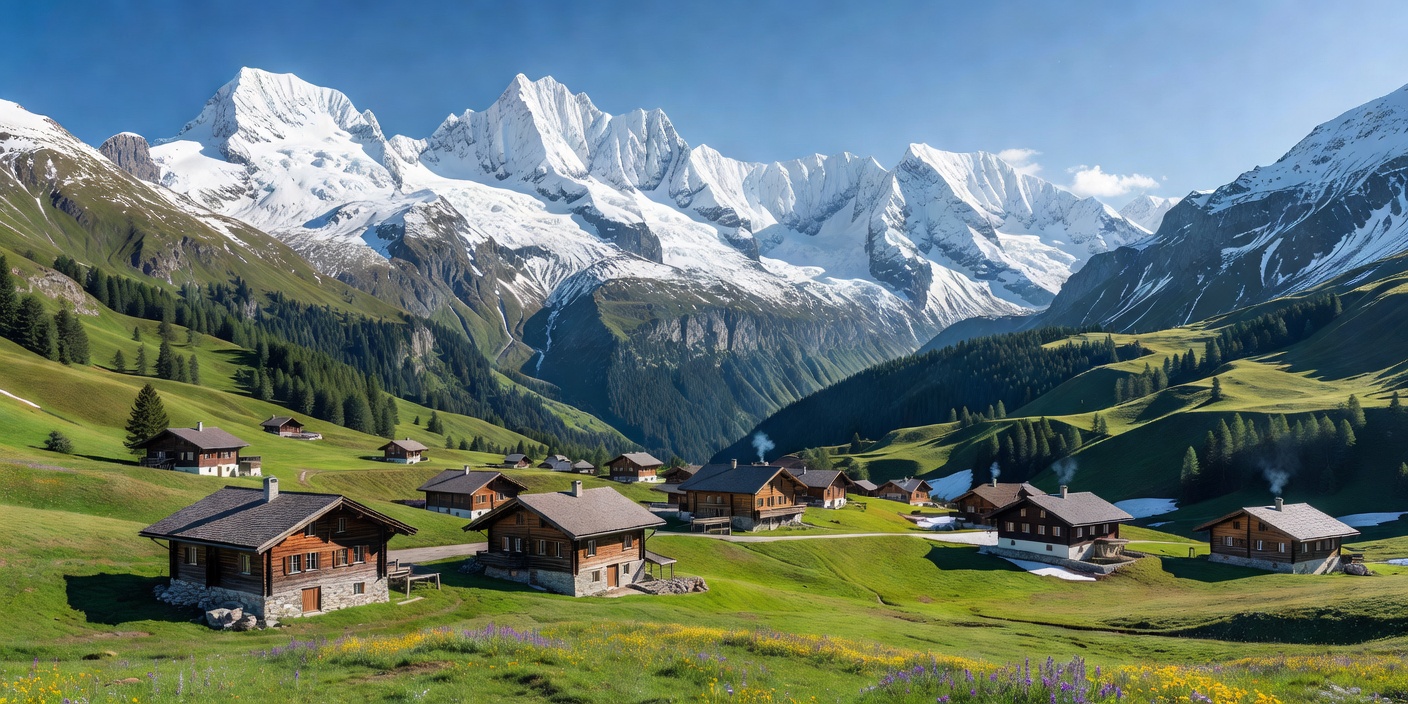
What is the Grand Tour?
Launched by Switzerland Tourism in 2015, the Grand Tour of Switzerland follows brown road signs bearing a white car icon. It starts and ends anywhere along the loop, and you can join or leave it at will. The route links the major cities of Zurich, Lucerne, Bern and Geneva with the Alps, Ticino and the Engadin valley.
Highlights along the loop
- Rhine Falls (Schaffhausen): Europe's largest plain waterfall, reached from the northern edge of the route.
- Appenzell and Lake Constance: Rolling green hills, timber farmhouses and the lakeside towns of eastern Switzerland.
- Engadin and St. Moritz: High-altitude lakes, pastel villages and the Swiss National Park, the country's only national park.
- Ticino and Lugano: Palm-lined promenades, Italian-speaking towns and lake views at Locarno and Ascona.
- Zermatt and the Matterhorn: Zermatt is car-free. Park at Täsch and take the 12-minute shuttle train into the village.
- Lake Geneva and Montreux: Terraced vineyards of Lavaux (UNESCO) and the lakeside Château de Chillon.
- Gruyères and Bern: Cheese, chocolate and the medieval old town of Bern, also a UNESCO site.
- Jungfrau region: Interlaken, Grindelwald and Lauterbrunnen's waterfall valley, with trains to the Jungfraujoch.
- Lucerne: The Chapel Bridge, Lake Lucerne steamers and the Rigi and Pilatus mountains.
Alpine passes
Many pass roads are only open in summer. Classic passes near the route, such as Susten, Grimsel and Furka, usually open around June and close by October or November depending on snow. Always check live conditions before choosing a mountain crossing, and have a lower-altitude backup plan, since tunnels such as the Gotthard Road Tunnel stay open year-round.
Driving tips
- Buy the motorway vignette. Swiss motorways require an annual vignette, which costs CHF 40. Rental cars from Switzerland usually include it. Buy electronically at e-vignette.ch or at border crossings and petrol stations.
- Respect speed limits. Typical limits are 50 km/h in towns, 80 km/h outside towns and 120 km/h on motorways. Fines can be heavy and are enforced strictly.
- Prepare for costs. Switzerland is one of Europe's most expensive countries for fuel, lodging and meals. Picnics from supermarkets such as Coop and Migros can cut costs.
- Give way to postbuses. On mountain roads, yellow PostBuses have priority and sound a distinctive three-tone horn at bends.
- Use public transport selectively. The Swiss rail network is superb. In big cities, park outside the centre and take trams.
Pros and cons
Pros
- Excellent roads and clear signage
- Huge variety, from cities to glaciers
- Easy to shorten or extend
Cons
- High prices across the board
- Mountain passes close for much of the year
- Busy in July and August