
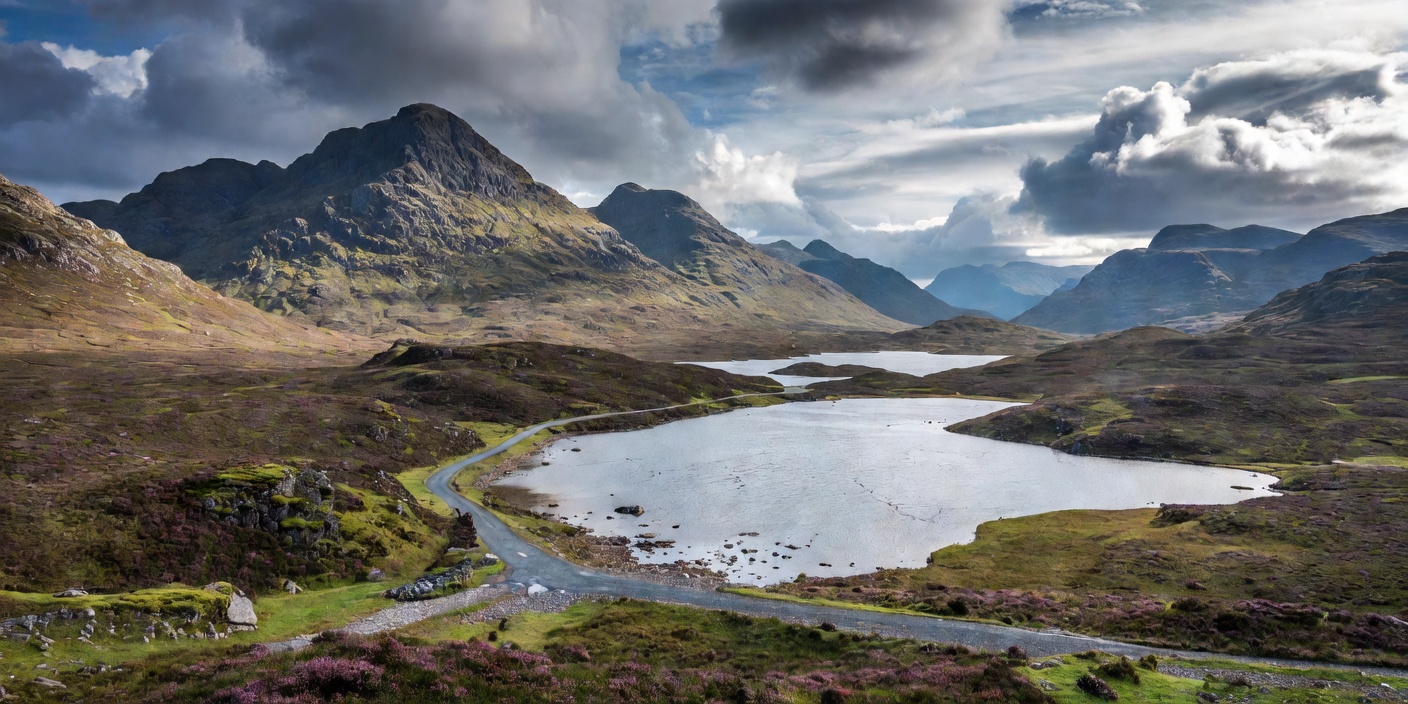
The route at a glance
Launched in 2015 by the North Highland Initiative, the North Coast 500 starts and finishes at Inverness Castle. Most drivers go anticlockwise, heading west first to catch the dramatic Applecross peninsula and Torridon mountains, then rounding the far north before returning down the east coast. Driving clockwise is equally valid and gives different light on the views.
Key stops
Inverness to Applecross
Follow the Beauly Firth, then cross to Wester Ross. The Bealach na Bà, whose name means "pass of the cattle," climbs to about 626 m with steep gradients and hairpin bends. It is one of Britain's highest roads, and trailers and large motorhomes are advised against it. The coastal road from Shieldaig via Applecross is an easier alternative for bigger vehicles.
Torridon, Gairloch and Ullapool
Glen Torridon is a masterpiece of red sandstone peaks. Gairloch has sandy beaches and whale-watching trips, and Ullapool is a lively fishing port with the area's best choice of cafés and fuel.
Assynt, Durness and the north coast
Inverpolly and Assynt show Scotland's ancient landscape of isolated peaks. Near Durness, Smoo Cave is a vast sea cave accessible on foot, and Balnakeil beach offers pale sand and clear water. The road across the north from Tongue to Thurso is wide, open and spectacular.
John o'Groats and the east coast
Stop at Dunnet Head, the mainland's most northerly point, then John o'Groats. Head south through Wick and Helmsdale. Dunrobin Castle near Golspie and the town of Dornoch finish the route with gentler scenery before the return to Inverness.
Driving tips
- Learn passing-place etiquette. On single-track roads, pull into a passing place on your left or stop opposite one on the right to let oncoming traffic pass. Wave thanks. Do not park in passing places.
- Plan fuel stops. Stations are far apart in the north-west. Refuel at Ullapool, Lochinver, Durness or Thurso before they become scarce, and never let the tank fall below a quarter.
- Book ahead. Accommodation and campsites fill months in advance in summer. Many hosts require minimum stays on weekends.
- Pack for midges. From late spring to early autumn, midges are most active at dawn, dusk and still, damp days. Repellent and a head net help.
- Drive on the left. Visitors from continental Europe should take extra care at junctions and roundabouts, particularly after rest stops.
- Respect local communities. Wild camp responsibly under Scottish access rights, take litter home and avoid blocking farm gates.
Pros and cons
Pros
- Remote beauty with wide-open roads
- Flexible length, from a long weekend to two weeks
- Whisky distilleries, seafood and castles along the way
Cons
- Single-track roads can be slow in peak months
- Limited fuel and EV charging in remote sections
- Weather can change quickly, even in summer
Local tip: Spring and early autumn give the best balance of long daylight, fewer midges and quieter roads.